The Hidden Architecture
In my previous article, I demonstrated the fatal flaws in the Golden Dawn and Crowley’s Thoth Tarot decan correspondences - how 56 cards (14 per suit) can never map with accuracy onto either the 52-week lunar year or the 36 gates of decan / solar time. You actually need playing cards, not Tarot, to find the true teaching. But there’s something equally profound that’s been overlooked entirely: How do court cards and decans relate? What is the role of courts within the decanic model?
Court cards are personality types, yes. You can look at them that way. From a cursory overview of the deck, one can certainly see them as the “people in your life.” And this is a useful perspective for card reading. But what if this is not an end point but an entry point – to a deepening master teaching that promises something even more.
Court cards, within the decan model of time and astrology, have been overlooked. After all, they’re not part of time. They have no place in the temporal structure. But what if this is the key to their higher understanding? What if their higher function is not as cogs in the wheel of time, but as gods, observers of time? Could they be the bearers of consciousness that stands outside the wheel of life and death? And when we comprehend their true relationship to the 36 gates of decan astrology, we unlock an ancient Egyptian initiatory rite of passage: the path from reincarnation to liberation.
Two Calendars, Two Paths
The 52-card playing card deck is a masterpiece of embedded wisdom containing two complete calendrical systems simultaneously. And these two systems embody two entirely different relationships to time itself, and two entirely different relationships between court cards and time.
It’s worth noting that both the decan system and the 52-card deck originate in Egypt. The decans, 360-degree divisions of the zodiac into 36 ten-degree segments, appear in Egyptian astronomical texts and tomb ceilings as early as the Middle Kingdom. And the earliest evidence of 52-card decks also traces back to Egypt, suggesting that this mathematical architecture preserving both lunar and solar time wasn’t coincidental but intentional - a sophisticated encoding of cosmic wisdom into a portable format.
THE LUNAR PATH – Humans as Bound to Time
- 52 cards = 52 weeks in the natural year
- 13 cards per suit = 13 lunar cycles / 13 weeks in each season
- 4 suits = 4 seasons
- Court cards INCLUDED in the count (part of the 13)
- This is the exoteric layer: tracking life’s cycles via the moon
- Courts are part of the wheel, without inherent hierarchy
- Shuffling enacts the law of chance and the looping path of incarnation
THE SOLAR PATH – Commanding Time (Liberation)
- 36 numbered cards (1-9 in four suits) = 36 decanic gates
- 16 court cards (10-13 in four suits) = OUTSIDE the gates / outside TIME
- Courts stand apart from the temporal cycle, where they become observers
- This is the esoteric layer: learning to transcend the cycles
- You master the lessons at each gate and achieve court consciousness
- Fixed Sequence tied to the non-fluctuating calendar of Equinox and Solstice = Order replaces chance
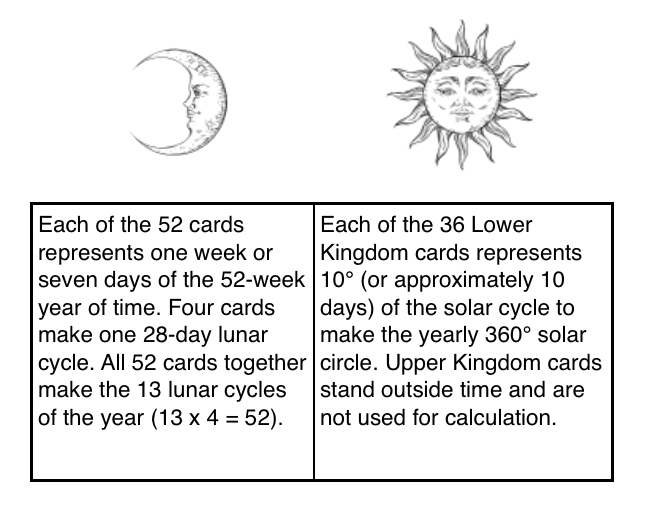
So how could the same 52 cards be both? The bigger question is how could it be otherwise? The original deck models time with such precision, it’s a mathematical inevitability. Both systems emerge organically from one elegant structure. Interlocking like Sun and Moon themselves. But to access the solar path – to escape time – we must learn to see and use the more subtle layer.
Part 2: Chance vs. Fixed Positions
Time as it appears in cards are not meant to be theoretical models. Cards are made to get your hands on. The 52-card deck presents two completely different ways of incorporating them into personal practice – and two different relationships to self knowledge.
The Lunar Method: Divination Through Chance
When you work with the moon, you shuffle all 52 cards together - courts and numbers tumbling in the same mix. Remember, 52 cards = 52 weeks. Each and every card marks 7 days of time. Cut the deck, count forward that many cards (weeks), and you’ve determined a date in the lunar calendar.
Who knows? The Lady of Diamonds might appear in the third week of the coming cycle, for example. Or the 7 of Clubs could land you nine weeks out. What matters is which card comes up through the randomness of the shuffle. You’re asking: “What’s my fortune? What’s coming? Where am I in the cycle right now?”
Lay the whole deck out in piles of four cards each (4 cards = 4 x 7 days = one 28-day lunar cycle) and you get 13 piles total – the 13 lunar cycles of the year. Courts and numbered cards alike are placeholders of time. There’s no inherent hierarchy. Every card is an equal player in the lawless realm of chance as the cards shuffle and fall.
This is divination as most people understand it: let the cards land where they may, and read what appears.
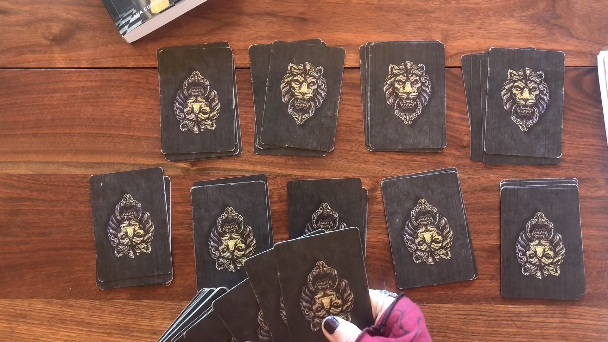
Lay out all cards in 4-card piles, and you get 13. 13 lunar cycles, each of 4 weeks or 28 days.
The Solar Method: Mastery Through Fixed Positions
Working solar operates on the opposite principle: the cards never move.
Ace through 9 in each of the four suits (elements) occupy fixed positions on the wheel of the solar year. Each season begins with the Ace (1) and proceeds through the 9. Beginning and ending. Four times, as the sun marks the Equinoxes and Solstices. Sequences repeat in a known, predictable fashion.
The 4 of Hearts always occupies the same position in the watery element’s yearly progression, for example. A known slice of time where the number 4 brings forth meanings that layer with elemental expressions, creating a spectrum of experience as unique as your own life and circumstances. One and the same card speaks to you differently at 25 than at 55, differently in grief than in joy, etc… The position is fixed; the depth is multi-faceted.
The 7 of Spades, as another example, always marks the same predictable time period or energetic threshold in the earth element’s cycle – but how you meet that threshold, what it asks of you, and what you discover there evolves as you do.
You’re not asking “what card will I draw?” You’re studying: “What does each gate teach? What energies regulate at the 6 of Diamonds position? How do I navigate the challenges that the 3 of Clubs presents at this moment of my life? What are the temptations, the familiar patterns, the pitfalls?”
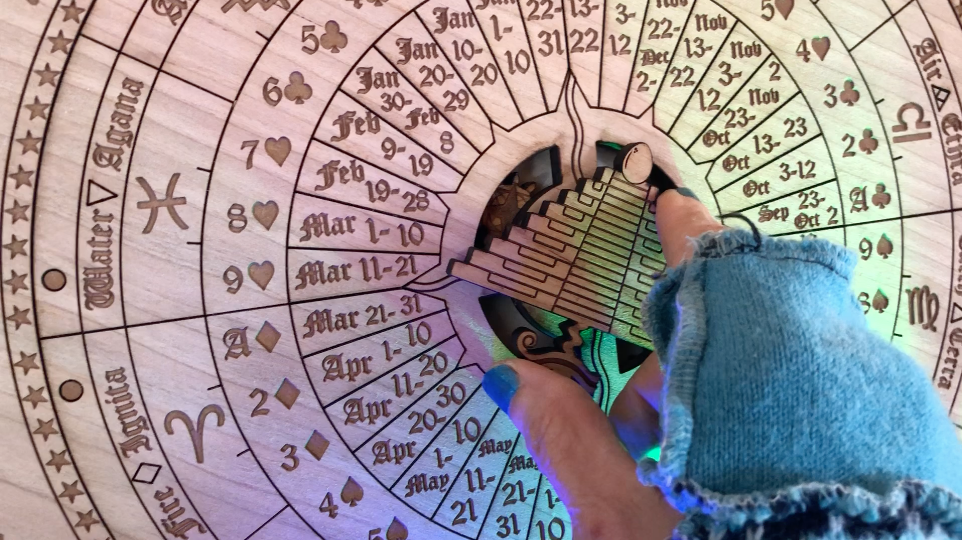
the numbers and suits of the 52-card deck as it maps onto the astrological decans
This is initiation interfacing with divination. You learn the 36 gates the way you’d learn a sacred text – through study, practice, and lived experience. And through that growing mastery, you develop the consciousness unique to courts: awareness that stands outside the wheel and the ability to command it. Courts ascend to become masters of the numerical and elemental spectrum, instead of at the mercy of it.
And isn’t it interesting: The Law of Chance vs. the Rules of the Game. Chaos vs. laws that set the parameters and determine the game board. Naturally, of course, we need both. Just like we need lunar and solar perspectives, just like we need the Sun and the Moon – both in the world and inside ourselves. But only one of these paths provides the great escape we ultimately seek for as human beings.
In The Doors of Somlipith, I map the complete correspondence system for all 36 gates, showing exactly where each card sits in the natural year (marked by Solstices and Equinoxes), and what each gate offers for study and energetic regulation. But the courts – those 16 figures standing outside the 36 gates – operate on yet another level entirely.
Wrapping Up: The 16 Masters
When we map the 36 decanic gates using cards 1-9 in each suit, we’re left with 16 cards standing outside that system: the courts. And when we restore the 10 to its rightful position as the Lady card (10 was never a lower number), we discover perfect archetypal balance:
10/Lady (even) – 11/Jack (odd) – 12/Queen (even) – 13/King (odd)
Feminine and masculine. Youth and maturity. Across all four elements. Sixteen complete pathways of human consciousness, together expressing the duality of existence: odd/even, red/black, male/female. This expands what we find in most modern decks, where you have a Jack, Queen, King court sequence. But when cards of the number 10 are curiously relegated to the lower numbers, from a numerological point of view, they are completely out of place. Historical precedent confirms the early existence of additional “Lady” cards, or 10’s as young female courts, which restores the harmonic balance. For example, Johannes of Basel’s 1377 account mentions 52 card decks with “a King and his attendant” and “a Queen and her attendant,” while early tarot decks like the Cary-Yale Visconti included six courts per suit: 3 male and 3 female.
This 16 card court restoration is what you’ll find in The Doors of Somlipithdeck by CJ Freeman – the Lady-Jack-Queen-King spectrum preserved as it was always meant to be, with full gate correspondences effortlessly mapping to the natural year.
Be aware: the decan correspondences presented here differ from the Golden Dawn and Crowley’s Thoth Tarot assignments. Their system maps cards 2-10 to the 36 decans (with Aces assigned to cardinal points), creating sequential numbering rather than true triads. More fundamentally, tarot’s structure – 56 cards instead of 52, with 14 cards per suit instead of 13 – breaks the codes of natural time. Fourteen cards cannot map to 13 lunar weeks. Forty numbered cards cannot align with 36 gates of the decans. Beautifully crafted imagery can never atone for the mathematical betrayal of Tarot.
For a detailed exploration, see my article “Crowley’s Fatal Flaw: A Review of the Thoth Tarot.”
The complete teaching – both lunar and solar, both chance and mastery – lives in the 52-card playing deck. Sixteen courts commanding thirty-six gates. The escape from reincarnation, hiding in plain sight.